


The first time I came across the story of Alphonse Ratisbonne was on a pilgrimage. I was young and on a life-changing trip with my parish to France and Italy. We were having Mass at the altar where Saint Maximilian Kolbe had celebrated his first Mass, and I was given the opportunity to be the lector. During that Mass, my fourteen-year-old heart was very well aware that we were not alone. While we are never alone, always surrounded by the saints and angels, that Mass brought the reality home in a very tangible way. My old friend, Maximilian, and my new friend, Alphonse, felt very close.
It was at that side altar in the church of San Andrea della Fratte in Rome that Alphonse Ratisbonne, a staunch anti-Catholic atheist, had a sudden and total conversion to the Faith after a vision of Our Lady. After conversations with Catholic friends and a challenge to wear the Miraculous Medal, Alphonse was in the church and had a vision of Mary as she is depicted on the medal. He fell to his knees, and although she spoke nothing to him, he recounted, “I understood the horrible state in which I had been, the deformation caused by sin, the beauty of the Catholic religion—in other words, I understood everything.” Moments later, he was begging to be baptized.
Seventy-seven years later, Maximilian would choose that altar for his first Mass as a priest, facing a beautiful image of Our Lady of the Miracle as Alphonse saw her. And many more decades later, I was lectoring at Mass, my heart learning lessons that my head already knew but now were becoming more tangible.
That’s one of the beautiful things about pilgrimage. My head knows that the saints have gone before us as models and witnesses. I know with my intellect that the saints are interceding for us in heaven, calling us onward to stay faithful and finish the race. But on pilgrimage, when you kneel beside the bed where Francisco Marto died, when you sit in the pews of the parish church where Saint Thérèse and her family attended Mass, when you walk the ancient Roman road under the church of St. Cecilia… the truths enter your heart.
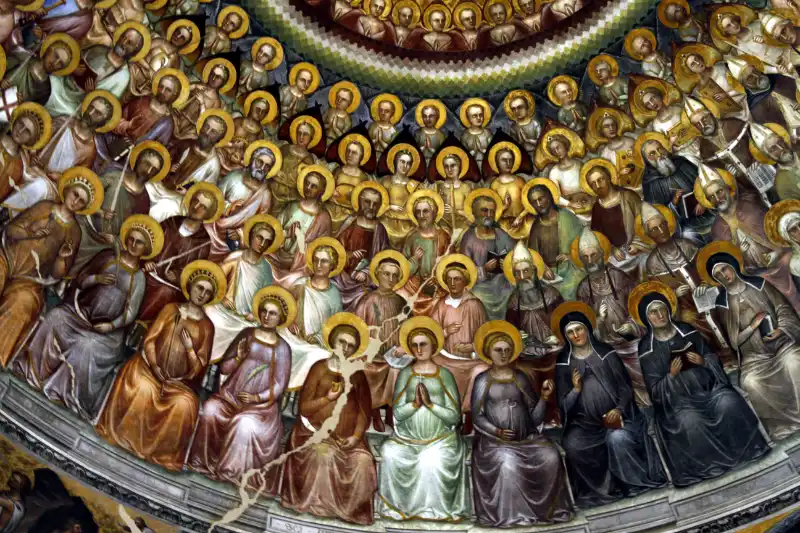
The saints are real people. On pilgrimage, the images on holy cards and stained glass windows are given flesh and blood. The saints were living, breathing humans who lived at particular times and places. They did very ordinary things and they struggled like you and me. When we find kinship with saints, we allow our hearts to be transformed by their witness and continue to learn through their friendship.
We encounter the saints on pilgrimage while visiting their own homes, mission fields, and their tombs, but we also encounter them as fellow pilgrims. Saint Thérèse came alive to me not just in Lisieux, but also in Rome, where she went on pilgrimage prior to entering Carmel. In the Basilica of Santa Cecilia, I’m not just walking in the footsteps of the Roman martyr, but also the French Carmelite nun. In Story of a Soul, Saint Thérèse reflects:
“Before my trip to Rome I didn’t have any special devotion to [Cecilia], but when I visited her house transformed into a church, the site of her martyrdom, when learning that she was proclaimed patroness of music . . . in memory of the virginal song she sang to her heavenly Spouse hidden in the depths of her heart, I felt more than devotion to her; it was the real tenderness of a friend.”
In many places throughout Europe, you walk in the footsteps of Saint Carlo Acutis. Growing up in Milan, he was surrounded by pilgrimage sites of great saints like Ambrose and John Bosco. During his young life he traveled extensively, including to Sagrada Familia in Barcelona, the Shrine of Our Lady of the Rosary in Pompeii, Rome, Montserrat, and Fatima. He convinced his family to include in their family vacations pilgrimages to sites of Eucharistic miracles and to Marian apparition sites.
Carlo was not just a pilgrim but also an evangelist for these places. After a pilgrimage to Lourdes, he told the story of Saint Bernadette to the mother of one of his friends, a Hindu. After conversations with Carlo about the Catholic faith, she went on pilgrimage there, and when she returned, she sought Baptism. Carlo’s favorite Eucharistic miracle site to speak about was Lanciano because of the ample scientific research undertaken on the miracle, and he loved to tell the story to Catholics to teach them about the Real Presence.
Going on pilgrimage for Catholics is not necessary or mandated. We can have a relationship with God and the saints without traveling to distant shrines. But if we have the opportunity, these moments of pilgrimage can be classrooms of grace. The saints become friends–not paintings in a book, but photos in your family photo album.
A few years ago, I made a pilgrimage across Rome to Saint Josemaria Escriva’s tomb. After my prayer, I wandered into the chapel that holds a number of his relics–things like his eyeglasses, his toothbrush, and his day planner. These were things I could relate to, these objects of daily living. These are the things that brought him closer to God; this was the work that he consecrated to the Lord. In that little room, I felt closer to a saint I had long admired. He became a friend. My heart was opened to the truth my head had already known: the saints are people, like me. Holiness like theirs is not far off; it is attainable if I am open to the work of the Lord in my life. And we have many, many friends in heaven who are ready to help us in that endeavor.
Joan Watson is a Catholic speaker and author of several books, including Making a Pilgrimage: A Companion for Catholics. She is also the pilgrim formation manager for Verso Ministries, a Catholic pilgrimage company. Her work can be found at joanwatson.faith.


