


When Mother Teresa and Pope John Paul II were canonized—in 2016 and 2014—I found myself reflecting on what a privilege it was to have lived my young adult years in the presence of saints.
They did not know me, but I knew them. I watched them, read them, and—on a few occasions—stood close enough to glimpse their humanity. Over time, I realized something surprising: holiness was not distant. It was unfolding in real time, in real lives, before my eyes.
Their holiness unfolded on the world stage—influencing the unfolding of history, moving the hearts of hundreds of thousands of people, and leading individual people to greater conversion and holiness.
When they died, it was as if the world had lost something very special, and it had.
Holiness is closer than we think—embodied in real people we’ve encountered—and the Eucharistic Revival is ultimately a call to become saints ourselves.
Moments of Grace: Encounters with American Saints
As the National Eucharistic Pilgrimage approaches, I’ve been rummaging through memories to see if I have had some connection to American saints. And I discovered I actually have!
When I was a child, I met Fulton Sheen (set to be beatified September 24). At an event at the St. Thomas More Cathedral in Arlington, Virginia, my mother sent the three of us kids up through a crowd of adults trying to get him to sign their books. She instructed us to ask him for his blessing. I’ll never forget his piercing eyes registering surprise, and the quiet way he pulled us aside for a blessing.
We used to have an American Catholic history book in our home library, and I was always impressed by Rose Philippine Duchesne. The story is recounted there that in her older years she would be found deep in prayer in the church within the mission with the Potawatomi tribe in eastern Kansas. Even when someone quietly crept up beside her when she was at prayer and stealthily arranged beads and seeds in an intricate pattern on her lap, she didn’t notice, so deep was she immersed in her conversation with God. She had come on the mission at the age of seventy-one on the insistence of Father Peter Verhaegen, who was one of the missionaries, who said, “She is coming with us. She may not be able to do much work, but she will assure success to the mission by praying for us.” Since Duchesne was unable to master their language, she could not teach, so she would spend long periods in prayer. The children named her “Quah-kak-ka-num-ad,” which translates as Woman Who Prays Always. That story has stayed with me as a seed for my own religious vocation.
Lastly, in 1988, less than two years before her death, Servant of God Thea Bowman recorded in our sound studio in Boston. I still remember the way her soul resonated in her voice, even as she was already very fragile because of her poor health. She inspired millions through the gift of Black sacred song, delivered in an unforgettable mezzo-soprano. She witnessed to Jesus with her loving attentiveness to each person she was with, and sought racial justice and racial harmony by promoting cultural awareness and the sharing of cultural gifts in the Church and beyond.
Through the years, I had visited the shrines of Elizabeth Ann Seton, Frances Cabrini, and John Neumann.
So what American saints have you rubbed elbows with?
For starters, a lot of us were reintroduced to Mother Cabrini through the 2024 movie Cabrini, directed by Alejandro Monteverde. Perhaps you’ve made a pilgrimage to a church or shrine where you could encounter one of these Americans who were giants in holiness.
Holiness Has Always Lived Here
After a little research, I discovered that there are over 100 Saints, Blesseds, Venerables, and Servants of God who lived and ministered in the United States.* From the first Mass offered on the soil of this country in August 1565, the grace of God has moved in the hearts of women and men—priests, bishops, religious, parents, and even children—in powerful ways. Each saint is a message through whom the Holy Spirit speaks to his people at a particular moment in history (see Pope Francis, Gaudete et exsultate, 21).
Figures like Saints Isaac Jogues and Kateri Tekakwitha, Blessed Stanley Rother, Venerable Augustus Tolton, Venerable Patrick Peyton, and Servant of God Gertrude Barber remind us that holiness has taken root in every corner of American life, joined by countless others—missionaries, parents, religious, and even children—whose causes continue today.
Some of these holy people lived in the 16th century. One died just 10 years ago.
Why the Saints Still Change the World
Benedict XVI assures us that only from the saints do we find the way to reform the world. “The saints show us the way to attain happiness, they show us how to be truly human. Through all the ups and downs of history, they were the true reformers who constantly rescued it from plunging into the valley of darkness” (Address of Pope Benedict XVI at Cologne—Marienfeld, August 20, 2005).
The saints show us the power of love over ideology and that the only definitive way to change the world is through a return to the living God who is “the guarantor of what is really good and true.”
This is why the National Eucharistic Revival and Pilgrimage is really all about holiness, about the power of God’s grace to renew the world, and about the power of love that alone can overcome everything we fear.
What does this mean in real life—in our real life? These four witnesses show us that holiness is not one path, but many.
Holiness in Our Own Time
Servant of God Michelle Duppong
I asked Cheryl Hansen about what she learned from her friend, FOCUS Missionary Michelle Duppong, who died on Christmas Day 2015, and is a Servant of God. Cheryl is the head of the Guild of the canonization cause for her friend. She shared with us: “Michelle Duppong’s witness of holiness has always struck me because it was so beautifully ordinary and deeply rooted in love of God. She showed that sanctity is not found in extraordinary recognition, but in daily fidelity—through joy, suffering, friendship, and a quiet yes to God in every season. For me personally, Michelle’s love for the Eucharist, her joy in suffering, and her deep trust in God’s providence have strengthened my own faith and encouraged me to seek God with greater simplicity and surrender.”
The Martyrs of La Florida
Reaching back into the 16th to 18th centuries, Father Andrew Fisher told us about the little-known Martyrs of La Florida, a group of fifty-eight Native American laity and Spanish-born clergy, who are Venerable. They died for their Catholic faith throughout the southeastern United States between the late 1500s and early 1700s. Their life of faith laid the foundation for our own. Father Fisher states: “Martyrdom is the supreme testimony; the most powerful summary of the gospel. Both in their day and today, the heroic faith of these fifty-eight martyrs teaches us that to share life with Jesus Christ and his Church is worth the price, no matter how great the cost. The Martyrs of La Florida give us inspiration, hope, and intercession as we seek to continue their work of evangelization in the land that is known today as the United States of America.”
Venerable Rose Hawthorne Lathrop
The Congregation of Saint Rose of Lima was founded in 1900 by Rose Hawthorne Lathrop (Mother Mary Alphonsa), the daughter of Nathaniel Hawthorne, to love Christ in the poor afflicted with incurable cancer. Rose was a convert to Catholicism and, in searching for a way to serve God and the poor, began her work of caring for incurable cancer patients on the Lower East Side of Manhattan. Sister Mary Joseph, OP shared with us that “Venerable Rose Hawthorne’s life teaches all of us that every life is sacred because each person is created in the image and likeness of God. She also offers a powerful reminder about the gift of faith in God who fulfills our every need.”
Servant of God Annella Zervas, OSB
The newest cause for canonization—Servant of God Annella Zervas, OSB—was officially opened in Minnesota in October 2025 by Bishop Andrew Cozzens of Crookston. After only one year as a sister, Sister Annella began experiencing what was later diagnosed as pityriasis rubra pilaris, a chronic and debilitating skin disease. Known for her positive attitude and good humor, she offered up her pain in unity with Christ’s suffering, trusting in Mary’s intercession and finding in the Eucharist her “greatest consolation.” After her death in 1926, people began to report receiving favors and miracles through the holy Benedictine nun’s intercession. Bishop Cozzens said: “Sister Annella is a daughter of the Diocese of Crookston, who was born and died in Moorhead, Minnesota. And she offers all of us an extraordinary example of deeply lived Catholic faith and deep trust in God.”
The Invitation Before Us
The National Pilgrimage is a call to holiness because saints are still what our country most needs today…that would be you and me.
Archbishop Nelson Pérez, along with the Church in Philadelphia, will host the closing events of the National Eucharistic Pilgrimage. He said, “It’s my joy, and that of the Church in Philadelphia, to host the closing events of the National Eucharistic Pilgrimage, which will be held in what I affectionately call the City of Saints. As the only diocese in the country that houses two saints, Saint Katherine Drexel and Saint John Neumann, this is the place that Catholics can reference to remember our history in this great country and the future we are building here. We will humbly and proudly bring Our Lord into the streets of this historic city to commemorate what is equally our heritage and our call as Christians to live as One Nation Under God.”
In 1976, our country’s 200th anniversary, the 41st International Eucharistic Congress was held in this same city: Philadelphia. How fitting that 50 years later, the 2026 Eucharistic Pilgrimage is making its way back to Philadelphia with One Nation Under God as our theme. At this Eucharistic Congress were three saints: Pope John Paul II, Mother Teresa, and Fulton Sheen.
The gift of grace continues, the call to holiness only intensifies, and our vocation to be saints remains very real!
Sr. Kathryn J. Hermes is a Daughter of St. Paul and serves the Eucharistic Revival as editor of Heart of the Revival. As an editor, author, and spiritual mentor, she focuses on holiness and healing so people can live in Christ. She can be found at https://touchingthesunrise.com/
*What does it mean to be recognized by the Catholic Church as Venerable and as Servant of God? The men and women of the United States recognized by the Catholic Church as Venerables have lived a life of heroic virtue recognized by the Pope. They have a long road to travel before they can be declared Saints, yet from each of them we can learn something important for living the Catholic faith fully. They are two miracles away from being recognized as saints. For each of the men and women who are referred to as Servants of God, the first step on the path to canonization, a bishop of a diocese of the Catholic Church has seen enough evidence of sanctity to deem it worthy to investigate the candidate’s life and propose to the Church that they be considered for sainthood.
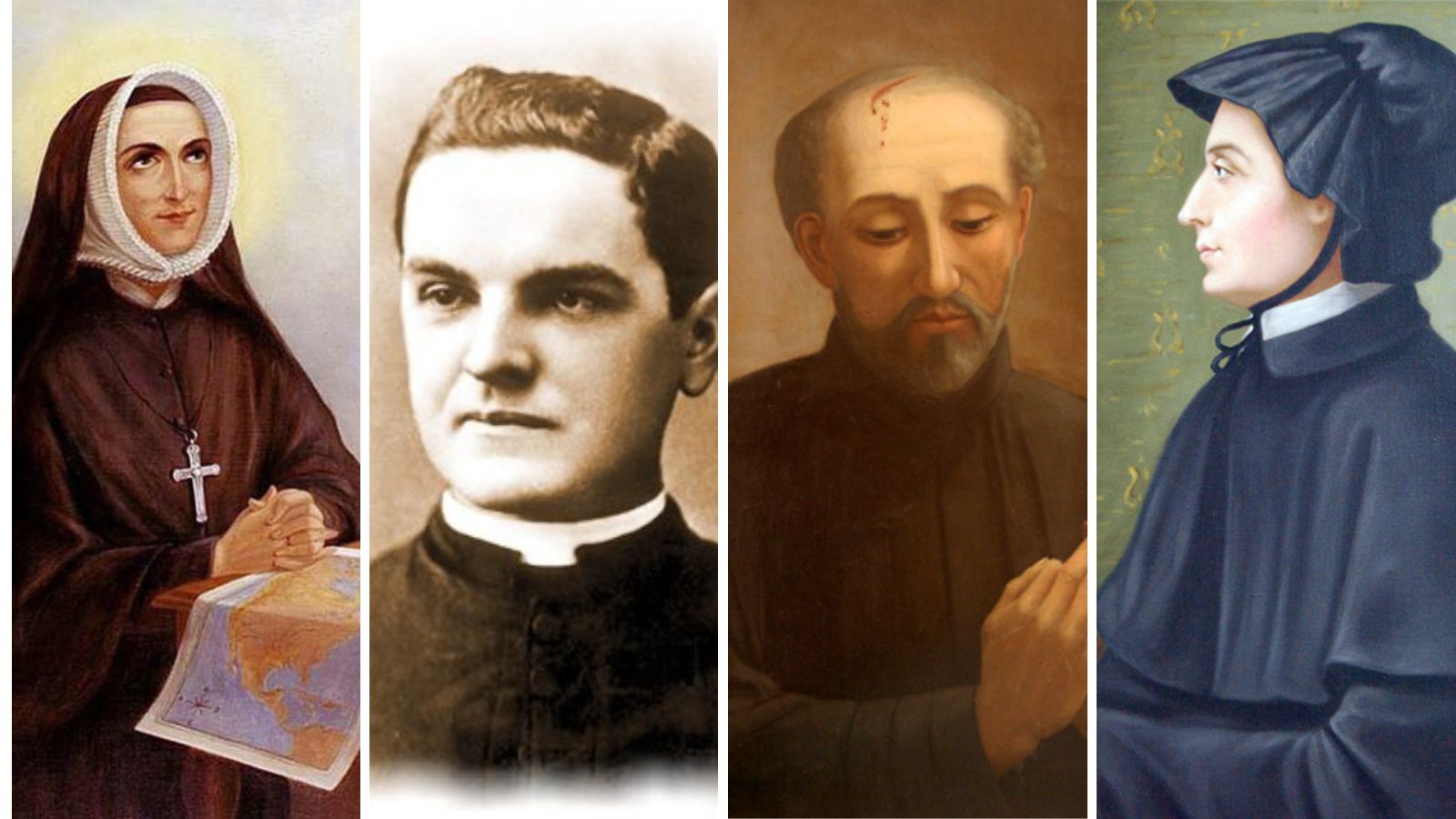
Images: Public Domain via Wikimedia Commons: St. Rose Philippine Duchesne, R.S.C.J., Bl. Michael J. McGivney, St. Isaac Jogues, S.J., St. Elizabeth Ann Seton, S.C.


