


Have you ever felt restless? With questions that the culture can’t seem to answer or with desires the world can’t seem to fulfill? Perhaps you are familiar with St. Augustine’s famous exclamation in his prayer to the Lord: “Thou hast formed us for Thyself, and our hearts are restless till they find rest in Thee” (Confessions, 1,1.5). But Augustine has more to say on the topic. He invites us to see our place in this world as pilgrims.
This life is a pilgrimage. And when we begin to see life this way, it changes how we live, how we pray, and how we suffer.
The word pilgrim comes from the Latin word peregrinus. In ancient Rome, peregrini were those who lived among citizens of Rome but were not citizens themselves. They were protected but did not have the scope of rights accorded to citizens. They lived among the citizens easily and usually unpersecuted, but still set apart. They could not marry citizens, for example. In classical writing, the word eventually came to have the connotation of wanderer, where we then derive our idea of pilgrim.
But before this word was used in a Christian context to describe someone journeying to a sacred destination, it was used by Augustine to describe someone journeying in the Christian life. He begins his great work City of God by acknowledging that Christians are peregrini. Writing his massive tome in response to the question of Christianity’s compatibility with the requirements of Roman citizenship, he begins by acknowledging that here on earth, the city of God “journeys as a pilgrim among sinners and lives by faith” (City of God, Book 1).
Throughout the work, he speaks of the unique situation we as Christians find ourselves in while living in society. Like peregrini in the Roman legal sense, we are living in a place with certain rights and obligations, but one that is not ultimately our home. Therefore, we might at times live differently or make different choices than those who do view it as home. Those citizens might not understand everything we as peregrini do. At best, they will tolerate us. At worse, they will persecute us. And we shouldn’t be surprised if they do. Because we are peregrini, and here we have no lasting city (Heb 13:14).
If there are times when you feel restless or out of place here, there is a reason. As the Letter to Diognetus said in the early days of the Church, Christians “pass their days on earth, but they are citizens of heaven.” We shouldn’t feel at home here! It is not that we do not love this place, but we do not love it more than our real home (see Matthew 6:19-21). It is not that we are never happy here, but that we are detached from what is passing.
We do not eschew the world completely – after all, it was created by God and it is our way to heaven! It is good and we are called to work in and with it. We have a responsibility to bring Christ into the world. But it will never be enough.
When we begin to live as pilgrims, our perspective and approach to life changes. Making decisions become a bit clearer: does this bring me closer or farther from heaven? Priorities sort themselves out: how do I work for the kingdom here on earth while keeping my eyes on its fulfillment in heaven? Even great suffering has an answer: it is passing, and the path of Calvary does not end on the Cross, but in resurrection.
When we become too comfortable here and lose sight of our true home, we stray from our pilgrim path to heaven. There is great danger in believing that this world is our ultimate home. We look to political leaders to be the answer to our problems. We seek answers and happiness in possessions, jobs, or relationships. We prioritize comfort and self. All of these things leave us unhappy, lonely, unfulfilled, and frustrated.
At first glance, perhaps this identity as a pilgrim might feel isolating. These places I love are not home? Everything is passing away? It is hard to find comfort in things that are ephemeral. But we take solace in the fact that the identity of pilgrim is a shared identity. This life is a pilgrimage, but it is not a pilgrimage undertaken alone. To return to Augustine’s image of the peregrinus, he uses the image in City of God to refer not just to an individual, but to an entire community.
One Augustine scholar noted, “There is nothing of Emersonian self-reliance in Augustine's thought on this subject. Peregrinatio is the essential activity (and being a peregrinus the essential characteristic) of the citizens of the city of God who dwell on earth. The very fact that they are here, separated from God by this trouble-filled and bothersome existence, urges them, with their companions, on, to reach the place where they know true happiness will lie for all.”[1]
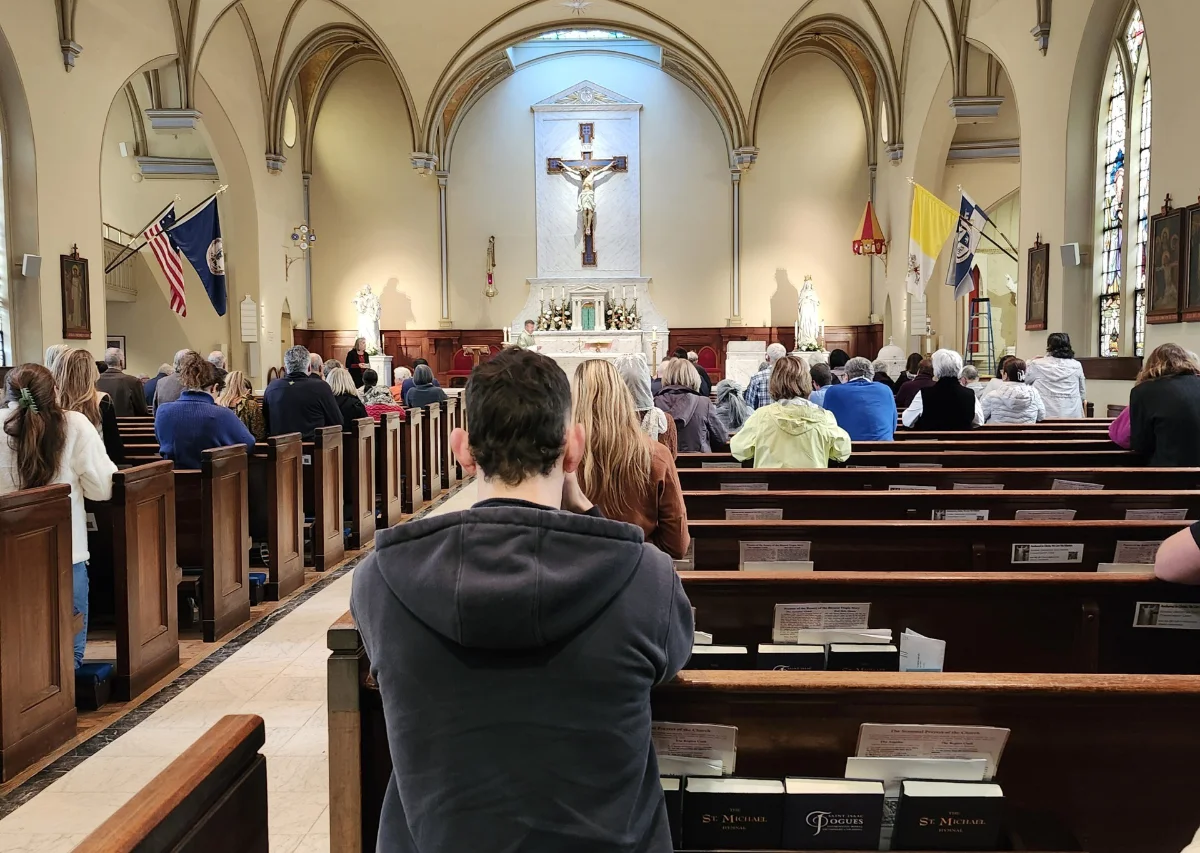
Look around at the people sitting with you in the pews at church. The very word we use for this community–parish–comes from the Greek for sojourner, paroikia. Our parish communities are groups of pilgrims! The parish is my home here on earth: it is where I received new life in Baptism, where I am fed at the table of the Lord, and where I give God right worship. But it is not just about me: we are on this pilgrimage together, and traveling together is safer and better than attempting it alone.
Let us reclaim our identity as pilgrims. Let us gather together around the Eucharistic altar where the Lord gives us viaticum, the food we need for the journey. Together, we are sojourners in a foreign land. If we live together with this perspective, we will live not in fear or anxiety, but in joyful hope.
Joan Watson is a Catholic speaker and author of several books, including Making a Pilgrimage: A Companion for Catholics. She is also the pilgrim formation manager for Verso Ministries, a Catholic pilgrimage company. Her work can be found at joanwatson.faith.
[1]M.A. Claussen, ‘“Peregrinatio’ and’ Peregrini‘ in Augustine’s ‘City of God,’” Traditio 46 (1991): 33–75, www.jstor.org/stable/27831259.


