


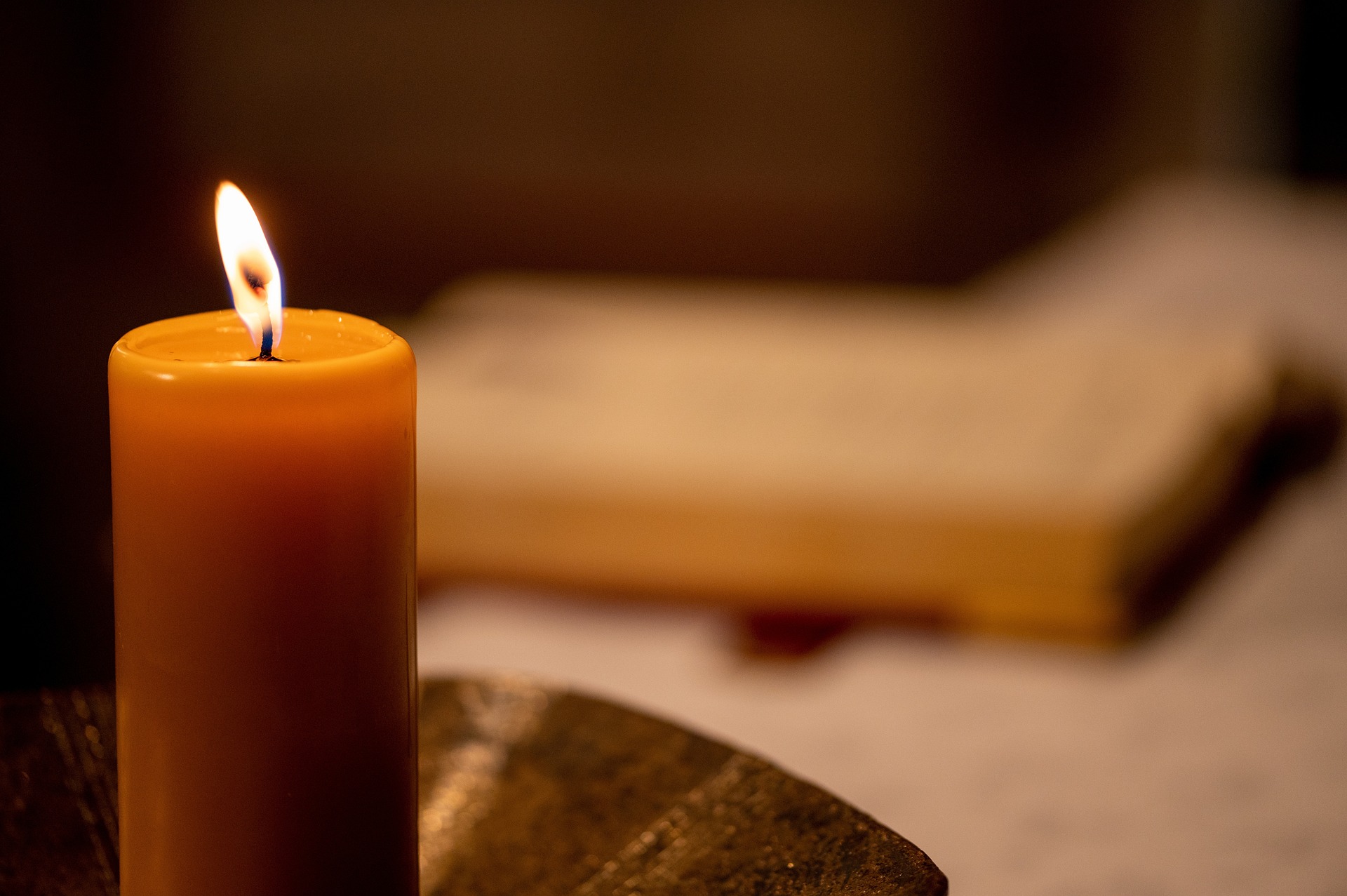
For just a few moments, I invite you to close your eyes and recall a significant experience of light… What kind of feelings are stirred up for you? How do you perceive the Lord communicating with you through this memory?
Maybe you recalled the first time you held your newborn child in the morning light. Perhaps the Saturday night lights of a high school football championship game flooded your mind. You might have seen a campfire around which you and your best friends gathered many years ago or a tiny candle glowing while you and a dear one sat quietly together.
Without light, our vision is paralyzed. The scientific phenomenon of light opens a world of visual stimulants for us: color, depth, perceiving body language and emotions, noticing what draws us and what repulses us.
But, what about our brothers and sisters who are visually impaired? Deprived of the light, are they just left in the dark? Perhaps in the created world they do suffer the loss of enjoying the manifold blessings that light offers. But they are not deprived of the warmth of the Son.
“Now this is the message that we have heard from [Jesus] and proclaim to you: God is light, and in him there is no darkness at all” (1 John 1:5).
The apostle John communicates to us a deeper reality of light, indeed the source of light: God himself. The motif of light and darkness is present throughout salvation history, from the very first lines of Genesis (Gen 1:1-5) to the plague of darkness over Egypt (Ex 10:21-24), from Joshua’s spies being saved by Rahab in the darkness (Josh 2) to the fall of Jericho in the morning light (Josh 6), from the betrayal of our Savior Jesus in the darkness of a garden to his glorious triumph made manifest in another garden at the dawn of Easter.
It is by the light of faith—kindled by God’s own love—that we encounter the living God: by remembering the great works of salvation history and by entering the Paschal Mystery made present in the celebration of the Mass. The drama of good and evil—unfolding in the scriptural imagery of light and darkness—permeates the Paschal Mystery and reveals its deepest meaning. Because of Jesus’ triumph, the light of the “Eighth Day” breaks into our world—eternity’s radiance slipping through the seams of time. The warmth of this light, received at Mass, sharpens our interior sight so that in the ordinary passages of life we may live as “children of the light” (1 Thess 5:5).
Because we are sensate beings, the Church gives us, even in the midst of the Mass, tangible rays of light that usher us toward the radiance that shines from the face of God. At many parishes, altar servers carry candles in the entrance procession, adding solemnity to the sacred mysteries we are about to celebrate. Candles always adorn the altar where Mass is celebrated, symbolizing the gravitas of our paschal memorial. A sanctuary candle—often in a red holder—glows quietly beside the tabernacle as a sign that Jesus, hidden in the Blessed Sacrament, is truly present within.
Before the advent of electricity, candles were placed throughout churches to illumine the sacred space. Natural sunlight still pours through stained glass windows, casting vivid colors upon the men and women who have gone before us—witnesses to how Christ, the Light of the World (Jn 8:12), dwells within his holy ones and shines through them. And in our modern era, innumerable forms of artificial lighting now creatively and evocatively enhance our liturgies.
As I was preparing to write this essay, I remembered a poem I wrote at the beginning of my Spiritual Exercises ten years ago. For me, the grace of this poem is how the Lord helped me know myself as a child of the light… and the power of the light of Christ within us.
Light
Light dancing on the pages
Illumines words ancient and new
To fill our minds with plenty
That plenty who is You
Yet light is unassuming
In her brilliance is her charge
For all she is enlightens
All we can be and are
Shining ever dutifully
She only is the beam
Radiating to glorify others
While she remains unseen
And yet this little ray emits
From mightiest of Kings
How could she ever be forlorn?
She is his everything.
Download Looking for Jesus, a Companion Children's Guide (available in English and Spanish), and coloring page (English | Spanish) created by Katie Bogner.
Sr. Alicia Torres is a member of the Franciscans of the Eucharist of Chicago. In addition to participating in the apostolic works of her religious community, she has been serving the National Eucharistic Revival since 2021.
Katherine Bogner is a Catholic school teacher from Central Illinois who is passionate about equipping parents, catechists, and teachers to share the beauty and truth of Christ and his Church with children. You can access her educational resources at her website. https://www.looktohimandberadiant.com/
Image Credit: Image by Klaus Prange from Pixabay


