


Long before he was elected Pope Benedict XVI, Joseph Ratzinger was a master catechist who had a gift for penetrating the heart of life’s deepest questions. One of those enduring challenges is as relevant today as ever, as we inhabit an age fascinated by the prospect of continually reinventing ourselves through technology. How do we become fully human? How, in other words, do we learn the art of living that leads to true happiness? The future pope’s reply was striking in its simplicity, as he paraphrased the words of Christ: “I will show you the path of life, the path toward happiness—or rather: I am that path.”
This fall, as we reflect on The Art of Living, Ratzinger’s answer remains as bold as it is relevant. In a word, to become fully human is to be conformed to the person of Jesus Christ. As the Second Vatican Council declared in one of its most celebrated passages, Christ “fully reveals man to himself and makes his supreme calling clear” (Gaudium et Spes, n. 22). Because Christ is not only true man but also the eternal Son of God, the Council’s claim carries a breathtaking implication: our destiny as bearers of God’s image is nothing less than participation in God’s own life.
Few teachings of the Christian faith are more startling than this one. Yet, as Cardinal Ratzinger observed, “We all thirst for the infinite: for an infinite freedom, for happiness without limits. . . . Man is not satisfied with solutions beneath the level of divinization.” Christianity’s bold vision of the human person isn’t an arbitrary invention. It corresponds to a longing written into the human heart itself.
From the beginning, the Church has proclaimed that the Word became flesh so that we who believe might become “partakers of the divine nature” (2 Pet 1:4 RSV). Highlighting this ancient doctrine of theosis, or divinization, the Catechism cites Saint Athanasius’ famous declaration: “The Son of God became man so that we might become God” (CCC, n. 460).
But how does this become concrete in our lives? As Pope Benedict often reminded his audiences, Christianity is not first and foremost an intellectual system, which means that “being a Christian is not the result of an ethical choice or a lofty idea” (Deus Caritas Est, n. 1). Thus, the way to become fully human—and thereby share in God’s own life—can’t be found in concepts alone. Despite the impression one might get from endless debates and hot takes on Catholic corners of the internet, being a Christian isn’t primarily about being right. It’s about an encounter with a Person.
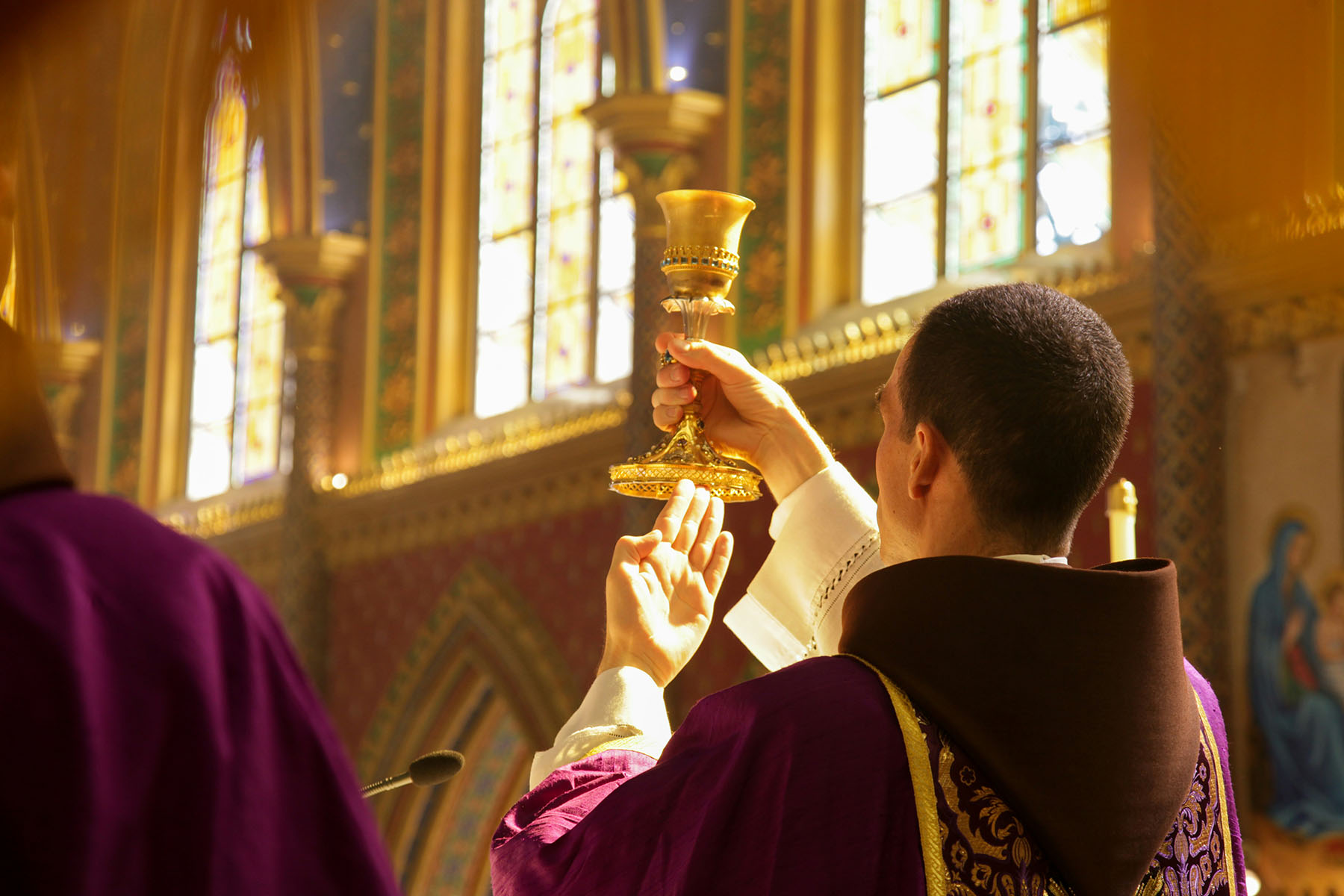
Nowhere is our calling to divine life made more tangible than in the Eucharist. As Vatican II teaches, in the liturgy the faithful “offer the Divine Victim to God, and offer themselves along with It” (Lumen Gentium, n. 11). Yet, as Saint Augustine reminds us, we are called not merely to receive Jesus in the Eucharist, but to become what we receive. In receiving Christ’s self-gift, we learn that our path to divine life is the same path he walked. The Eucharist reveals that our road to theosis runs through kenosis: the way of self-emptying love.
This vision sheds light on a tension that many of us experience every day: We yearn for glory, yet we’re constantly beset by limitations of dependence, weakness, and suffering that often seem to know no end.
Pope Leo XIV puts his finger on this paradox when he describes the human person as a “covenant between glory and fragility” (Magnifica Humanitas, n. 239). We who bear God’s image are at once dust and breath (Genesis 2:7). On the one hand, we possess a dignity that is without rival on earth. Our bodies are temples of the Holy Spirit, and our destiny is a divine communion so intimate that Christian tradition describes it as nothing less than “becoming God” by grace. On the other hand, we remain finite, vulnerable, mortal creatures. Perhaps nowhere is this tension more beautifully expressed than in Psalm 8: “What is man that you are mindful of him?” the psalmist asks in wonder. Yet he immediately adds that God has made humanity “little less than God.”
This exalted vision of humanity should never be confused with the spirit of self-assertion so prevalent in our culture. We already know how that story ends in the Garden of Eden. Today, many seek fulfillment through what Pope Leo calls “technological divinization” (Magnifica Humanitas, n. 126), imagining that human flourishing consists in overcoming every form of limitation associated with our creaturely state. Against this mindset, the Christian faith proposes that our greatness lies in receiving suffering as a gift and allowing it to be transformed by grace.
This is not to deny the many legitimate benefits that technology can provide. Speaking personally, I owe my life to medical advances that would have been unimaginable only a generation ago. Having undergone a kidney transplant, open-heart surgery, and cancer treatment, I can only regard many modern developments with profound gratitude. Even so, Pope Leo rightly reminds us that no technological development can heal the deepest wounds of the human heart. In fact, the Holy Father says of our trials, “To eliminate suffering would mean, in the end, extinguishing love and desire as well” (MH, n. 120). Here, the pope identifies the inseparable union of glory and fragility in the human person, consoling us with the truth that “humanity flourishes not despite limitations, but often through them” (MH, n. 118). Indeed, he argues, it is precisely our sufferings that give rise to compassion, generosity, sincere concern for others, and openness to God (MH, n. 119).
The reason for this goes back to Christ himself. Pope Leo says nothing novel when he insists that Jesus himself reveals humanity in all its grandeur. In Christ—the new Adam—we behold the human person as God intended man to be. Vatican II put it beautifully: “It is only in the mystery of the Word made flesh that the mystery of humanity truly becomes clear” (Magnifica Humanitas, n. 1; Gaudium et Spes, n. 22).
However, there’s a catch: the only way for you to know this fully is to live it. The truth and beauty of Christianity simply can’t be grasped from the perspective of an outside observer. To drive this point home, Benedict XVI once compared the Catholic Church to a Gothic cathedral with magnificent stained-glass windows. Viewed from the outside, it can appear dark, worn, and unimpressive. Yet, from the inside, once we step into the Church and lift our gaze to God, its beauty shines in full radiant splendor. In the words of the late pontiff: “It is only from the inside, from the experience of faith and ecclesial life, that we see the Church as she truly is: flooded with grace, resplendent in beauty” (Homily of April 19, 2008). If you find yourself in doubt, take Benedict’s challenge and try what he called “the experiment of faith” for yourself.
And here we see why the Eucharist remains the heart of every authentic renewal. At the altar, glory and fragility meet as Christ invites us into his own self-offering. Day after day, week after week, the God who made the stars gives himself to us under the humble appearances of bread and wine. Here we encounter the living Lord who reveals both who God is and who we are called to become. In the Eucharist, the mystery of divinization becomes a lived reality, for Christ gives us his own life so that we may share it. Becoming what we receive, we are sent forth to carry his incarnate presence into our homes, our parishes, our workplaces, and the wider world.
Matthew J. Ramage, Ph.D., is Professor of Theology at Benedictine College and co-director of its Center for Integral Ecology. The author or contributor to over thirty books, he explores this essay’s theme at greater length in The Experiment of Faith: Pope Benedict XVI on Living the Theological Virtues in a Secular Age (CUA Press, 2020). More on Dr. Ramage’s work can be found on his website www.matthewramage.com.
Image credit: Photo by Sustentação AP on Unsplash


