


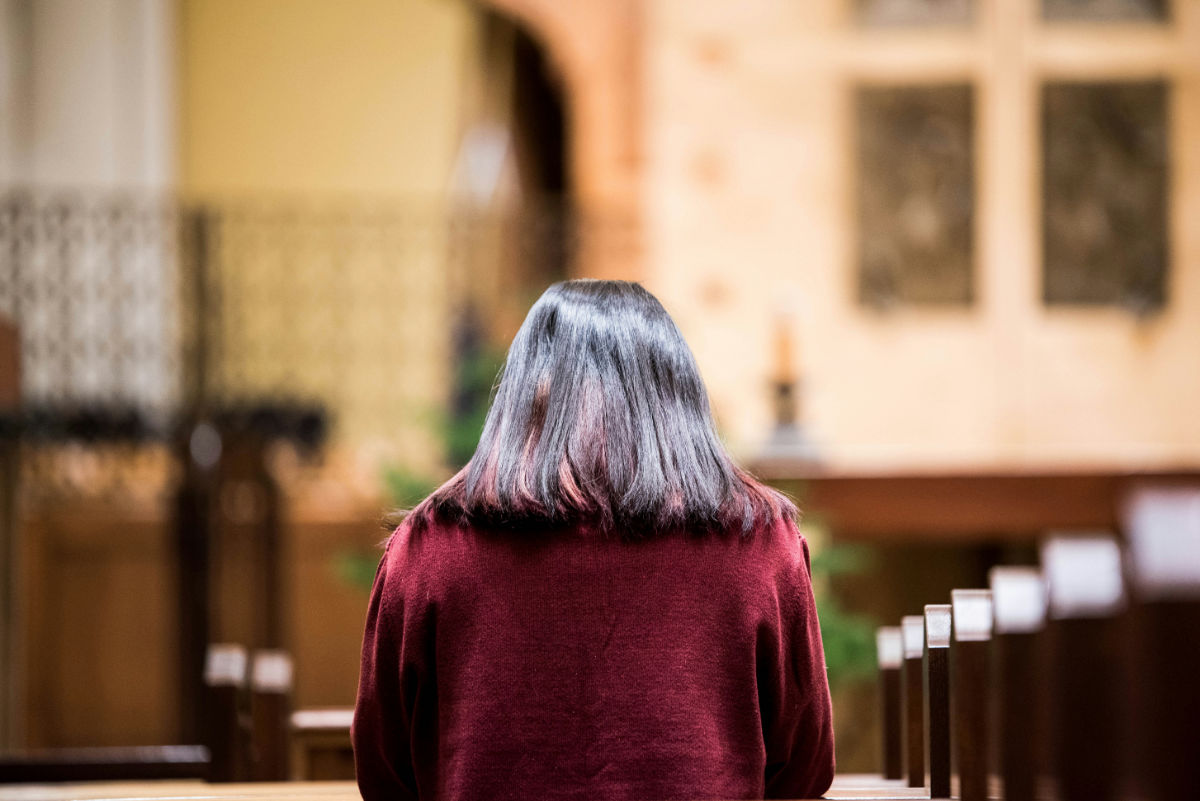
“When you pray, go to your inner room, close the door, and pray to your Father in secret. And your Father who sees in secret will repay you” (Mt. 6:6). Amid the clamor of responsibilities and distractions in our daily lives, the Lord invites us to enter into prayer with God and in so doing to form a deeper relationship with him. When we pray, we enter into that “inner room,” a school of the heart and mind in the interiority of our souls, as many of the Fathers of the Church taught.
Prayer: a School that Changes Us
The Catechism of the Catholic Church (CCC) presents prayer precisely in this way—as an act and habit that forms and shapes us, drawing us into deeper communion with God. Drawing from the Catechism’s teachings and the witness of Sacred Scripture, it is fitting to consider how this school of the heart and mind changes us, directing our aspirations and desires into concrete and positive actions through sustained dialogue with God and by his grace.
Prayer as an Ascent
The Catechism describes prayer as an ascent. “Prayer is the raising of one’s mind and heart to God or the requesting of good things from God” (CCC, 2559, quoting St. John Damascene). Yet we should realize that prayer is not primarily our own effort, but a response to God “who first seeks us” and who “thirsts that we may thirst for him” (cf. CCC 2560). Although prayer often is spoken and manifest visibly, it springs from an interior desire of the soul that God himself prompts within us.
In the Psalms, David cries out, “O God, you are my God—it is you I seek! For you my body yearns; for you my soul thirsts, In a land parched, lifeless, and without water” (Ps 63:2). David shows us that the external aspects of prayer, and all the habits and ritual that give form to acts of prayer, arise from an interior recognition that we depend on God for our very lives, and so we should naturally desire to conform our hearts and minds to the good and loving God who desires only happiness for his children.
Sacred Scripture and the Catechism remind us that our interior life is cultivated through deliberate actions, including our conscious turning away from the superficial and toward the One who knows us intimately: “Even before a word is on my tongue, Lord, you know it all” (Ps 139:4).
Prayer as Relationship
Prayer is how we practice a real and sincere relationship with God. “According to Scripture, it is the heart that prays,” the Catechism teaches. “The heart is the place of decision, deeper than our psychic drives. It is the place of truth, where we choose life or death. It is the place of encounter, because as image of God we live in relation.”
The heart is the inner room where all the faithful, by virtue of having been united with Christ in Baptism, may enjoy communion with God through prayer. “Christian prayer is a covenant relationship between God and man in Christ” and “extends throughout the Church, which is his Body” (CCC 2562-2565).
Prayer: Where God Awaits Us
When we pray, we enter a sacred space where God awaits. The Catechism teaches that prayer forms the heart by aligning it with God’s will, as Jesus himself modeled in Gethsemane when he prayed to the Father “not my will but yours be done” (Lk 22:42). This is not always easy because the allure of distractions, the experience of dryness, and other temptations threaten to pull us away from relationship—yet these very struggles help school the mind and heart in attentiveness, sincerity and perseverance. For this reason, the Catechism cautions that prayer “always presupposes effort” and that “prayer is a battle” chiefly against ourselves (CCC 2725).
“Pray without ceasing,” Saint Paul exhorts us (1 Thess 5:17). Prayer, even and perhaps especially when we wish to avoid it, becomes a necessary and practical discipline for growth in the Christian life. If we want to further our relationship with the Lord, we simply must find ways to integrate prayer into the rhythm of daily life—whether through morning offerings, evening recollections, or spontaneous conversation with God amid our daily tasks.
Prayer that Nourishes the Interior Life
The Catechism tells us how our interior life is nurtured through various expressions of prayer, each acting as a lesson in the school of the heart and mind. Vocal prayer, for instance, engages the body and senses, but it must flow from the heart to avoid empty repetition.
Vocal prayer, like the Our Father and many other familiar prayers we have learned, draws us into a greater awareness of our filial relationship with God, attuning us to praise and petition. Mental prayer, or prayerful recollection, draws us to reflect on Sacred Scripture or the mysteries of faith.
“Meditation engages thought, imagination, emotion, and desire,” the Catechism teaches (CCC 2708). In this way, our prayer can be modeled on that of the Blessed Virgin Mary, who “kept all these things, reflecting on them in her heart” (Lk 2:19). Thus, in ruminating on God’s Word according to our Blessed Mother’s example, all our desires may be rightly ordered for our good and the good of all our brothers and sisters. Contemplative prayer, finally, is described as “a gaze of faith, fixed on Jesus” (CCC 2715). It is a silent, loving communion where the heart rests in God, akin to the disciples’ request: “Lord, teach us to pray” (Lk 11:1).
Prayer in Eucharistic Adoration
A wonderful means of putting these expressions of prayer into practice is Eucharistic Adoration. One lesson from the 2024 National Eucharistic Congress and the Eucharistic Revival associated with it was the beauty of time spent in Adoration of the Lord in the Holy Eucharist. Prayer before Christ present in the Blessed Sacrament not only helps us come closer to the Lord individually, but it opens our hearts to the needs of all our brothers and sisters in the Church and in the world.
When we pray in Adoration, whether vocally, through meditation or in a contemplative way, we place ourselves in the presence of Christ who redeemed us all in an act of sacrificial love. Realizing this great truth trains our minds and hearts to take on the features of Jesus and to give ourselves in loving service to God and neighbor. In this way, the “inner room” of our hearts becomes a kind of sanctuary where the Lord nourishes us with his grace and where we can hear his voice quietly sending us forth to be his missionary disciples in the world.
By our commitment to fervent and frequent prayer in all its forms, may we come to know the love of God that has been poured out into us (cf. Rom. 5:5) and grow in friendship with the Lord, who desires nothing less than our whole heart.
The Most Reverend Michael F. Burbidge is bishop of the Diocese of Arlington, Virginia.


