


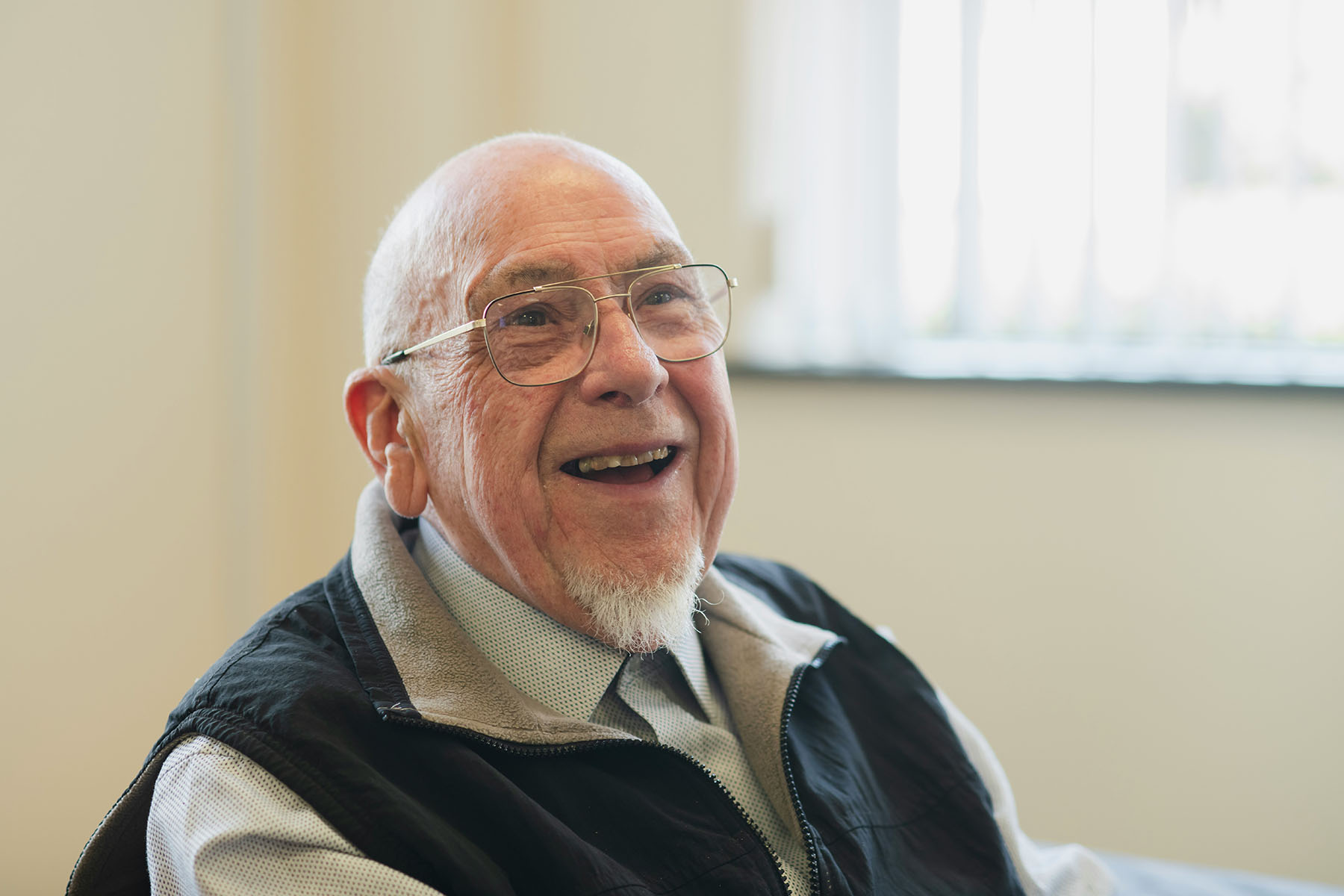
His hands were bumpy and bent, creased and crumpled. Years of rheumatism did the damage. Fingers hung at strange angles, never to straighten again. But he worked with those hands and I watched him work with a mix of admiration and fascination. He'd fix himself coffee, drive the car, or button his shirt (he only wore button-downs) with a tool he made that would slide the button through the hole when fingers couldn’t maneuver it anymore.
My grandfather's whole frame was bent, in fact. And it got more bent as time wore on, as if some huge weight was on his shoulders. He became crippled around age forty and died about forty years later. For forty years he had to wander the desert of physical and emotional pain as an autoimmune disease slowly destroyed cartilage and bone, and bone cancer eventually finished him off. In this desert, he found a way to live. He discovered the art of living. For him, the art of living was a skill, honed over the years through trial and error. Probably more failure than success. What mattered was trying. To keep on living. To live spiritually and to live grounded. This was more an art than a science. Medical science could tell him what he had and make countless futile attempts to "beat it," or at least keep the pain at bay. But one can't live by the hard lines of science and the false hopes of medicine. You learn the art of living by living within your limits, by humbly entering into the mystery of life with hands open instead of clenched — even if you can't open them all the way.
So my grandfather's path to sanctity went by the way of painful, physical purification. His coming to know the art of living came through his hobbled walk with his God. And this was the gift he gave my family. He showed us the art of living in his smile, in his availability, in his faith, in his front porch wave, in his patience, in his hugs that probably hurt to give, in his careful words, in his suffering, and in his country handshake that he'd offer to friend or foe (if he had one), simply because "you shake another man's hand."
My grandfather showed me the art of living.
Human beings are funny creatures. Unlike most of the animal kingdom, we are almost completely helpless from the get-go, and we take a long time to develop, both bodily and mentally. And even when we are fully developed, life remains a question as to how it will be realized in each person, unlike the cow or that cat, each of which realizes its life like pretty much every other cat or cow that’s ever lived.
In an address to religious educators in December 2000, Joseph Ratzinger reflected on this reality, saying:
Human life cannot be realized by itself. Our life is an open question, an incomplete project, still to be brought to fruition and realized. Each man's fundamental question is: How will this be realized—becoming man? How does one learn the art of living? Which is the path toward happiness?
How do you make a human being? How do you get made into a human being? A good one? How do you live life well? Realize its possibilities? Be whole and happy?
Well, up till Jesus arrived on the scene, nobody really knew because nobody could know. Being fallen was the norm. Humanity was stuck in a postlapsarian state and spinning its collective wheels. I once heard an analogy to explain this and I think about it often, because the fallen humanity around us and my own fallenness affords me plenty of opportunities to think about it. In the metaphor, everyone is driving around with almost completely flat tires. Traveling is slow and difficult. But, since everyone’s tires are flat, everyone thinks this is normal. Then Jesus arrives on the scene and he’s driving a vehicle with fully inflated tires. Watching him motor around, two things would happen simultaneously: you’d finally understand what driving is supposed to be like, and you’d look at your own pathetic situation and see the gap between your wheels and his.
So, this is the case for us. In Jesus and in the Cross, we see the heights of love to which we are called, and we simultaneously see where we really are in relation to it. And, there’s a gap. Thanks be to God we’re not left on our own to overcome it. Jesus himself, in his person, shows us the art of living and invites us to learn it by participating in it. Ratzinger thus exclaims: “At the beginning of his public life Jesus says: I have come to evangelize the poor’ (Luke 4:18); this means: ‘I have the response to your fundamental question; I will show you the path of life, the path toward happiness—or rather: I am that path.’”
To evangelize means to reveal this path—to teach the art of complete living. At the beginning of his public life, Jesus says: "I have come to evangelize the poor" (Luke 4:18). This means, "I have come to respond to the fundamental question of your existence. I am here to show you the path of life, the path to happiness. I am, in fact, that path."
Did you catch that last line from Ratzinger? “I will show you the path…rather, I am the path.” The art of living is not an abstraction, but something real accomplished by Christ in us. So it has more to do with surrender and unity of will than developing a particular skill set. In other words, this all runs deeper than WWJD (What Would Jesus Do). The art of living, in a Christian sense, has more to do with allowing Christ to live in me. It has everything to do with that, actually. The art of Christian living means reliving Christ, here and now. Not just WWJD, but WIJD (What Is Jesus Doing). The Catechism moves along this same progression, first noting that “in all of his life Jesus presents himself as our model (§520), before going further to say, “Christ enables us to live in him all that he himself lived, and he lives it in us” (§521).
Jesus doesn’t want to just show us the art of living; he wants to live it in us. And he invites us to live in him all he lived and to live it out in us principally through the sacraments of initiation and living the sacramental life of the church — meaning frequent confession and participation in the Holy Mass. In the Sacraments, and in a particular way in the Eucharist, this art of living, this reliving Christ, takes on a profound realism. The Eucharist is that true Wonder Bread, that miracle food that doesn’t work like any other food we eat that becomes part of us. Instead, the supersubstantial bread of the Eucharist is stronger than us. So by receiving the Eucharist, we are transformed (often slowly and almost imperceptibly) into Christ. Through the encounters with Christ in the Sacraments, he comes to take up residence in our souls and lives through us — if we’re open to it. Here, I have in mind some great imagery from Ven. Madeleine Delbrêl as she considers what it looks like to relive Christ:
"Lord, Lord, at least let this rind that covers me not be a barrier to you. Pass through. My eyes, my hands, my mouth are yours. This woman so sad before me: here is my mouth so that you can smile at her. This child is almost gray, he is so pale: here are my eyes so that you can look upon him. This man so tired, so very tired, here is my whole body so that you can give him my seat, and my voice so that you can say very gently to him: 'Sit down.' This boy, so smug, so foolish, so tough, here is my heart for you to love him with, harder than he has ever been loved" (1).
The Christian art of living means learning to live as Christ lived, or, better, learning to cooperate with Christ’s life in us that moves through our being like leaven in the dough, the “stuff,” of our lives. From my little window into his life, it seems my grandfather opened himself in this way. He embraced the yoke of the meek and humble teacher by becoming humble and meek himself. He let Jesus carry his Cross in him, and so my grandfather shuffled along the Way of the Cross and learned the art of living in the process. This was the gift he offered to my family, a gift akin to that described in the poem attributed to Saint Teresa of Avila: “Christ has no body but yours, / No hands, no feet on earth but yours.” In the case of my grandfather, it was a body and hands and feet mangled and battered by illness, but it was a body open to Christ’s, and this was all that mattered.
Brad Bursa is director of evangelization for the Stella Maris Family of Parishes in Cincinnati, Ohio. He is the father of eight children and the author of Because He Has Spoken to Us.
1. Madeleine Delbrêl, The Holiness of Ordinary People, edit. Gilles François and Bernard Pitaud, trans. Mary Dudro Gordon and Abigail Tardiff (San Francisco: Ignatius Press, 2024). 82.


