


In honor of the 250th anniversary of the United States, I was asked to address the relationship between unity and the Eucharist.
I'm pleased to do so for several reasons. First, I've always been fascinated by Saint Augustine of Hippo's sermon delivered to the newly baptized describing the meaning of the Eucharist. For these neophytes, Augustine reminds them that the Eucharistic mystery is not only a gift but a responsibility.
The Church must become who she receives in this Eucharistic mystery. She must become Christ's Body, inviting all human beings to the Supper of the Lamb. The Eucharist is the sacrament of unity in which the Church remembers who she is, born from the side of Christ upon the cross, a communion made possible through God's love.
Saint Thomas Aquinas in fact taught that the ultimate reality of the Eucharist is an increase in charity within the whole Church. You know you are a Eucharistic people if you love one another.
But that brings me to the second reason why I'm very pleased to offer this reflection on Eucharistic unity. Within the Church and the nation, especially right now, unity is hard to find. If you go online, you see the vicious hatred of fellow Catholics. “You go to the wrong liturgy.” “You don't dress properly for Mass.” “You're too liberal.” “You're too conservative.” “You're not focused on what really matters.” “You're a Catholic in name only.” It doesn't matter if you're a Bishop, a priest, a religious, or a layperson. There is someone in this online world who is going to hate you.
Such hatred, dear friends, is even more present in the public square. Too often we turn on the news and see yet another mass shooting or an assassination. The rhetoric of our politicians has become increasingly violent. I receive dozens of text messages during elections telling me that if I don't vote for this or that person, I will destroy America. It's hard to believe with so much division and despair that our nation will make it much past 250 years.
What are we as Catholics going to do about this disease of disunity?
From 2022 to 2025, the Church celebrated a Eucharistic revival intended to lead Catholics toward deeper belief and love of Christ's true presence in the Eucharist. The next step of this revival, let me suggest, is to inspire in Catholics a deeper love of Eucharistic unity.
Pope Leo’s motto should function as our inspiration: In illo uno unum. Taken from Saint Augustine, this Latin phrase means that in the one Christ we are made one. Nothing else can bring us together than Christ and the power of the Spirit that binds the baptized together.
We know that we love Christ and his presence in the Eucharist if we have become agents of unity in our neighborhoods, villages, cities, and nation.
A Eucharistic people are called to be a people of unity.
For the rest of our time together, let me suggest three ways that we Catholics who go to Mass might learn to be agents of unity in our nation.
First, we are a communion of sinners and not the righteous.
Second, our unity is not self-created but the result of Christ’s self-giving love.
Third, as recipients of this love, we are called to offer that return gift of love wherever the Lord has called us.
We Are a Communion of Sinners
Disunity, both in the Church and in our nation, is based on a certain blame game. It’s your fault, it’s your fault, it’s your most grievous fault. In the Mass, though, it’s different. We gather together at the beginning of every Liturgy and proclaim ourselves not among the righteous, but those in need of grace. We are the sinners. It’s my fault. My fault. My most grievous fault.
All of us together are at fault. We have failed to love. To hold up the rigorous ideal that has brought us together in Christ's Body.
Believe it or not, this used to be the attitude of the whole United States. The pilgrims, who saw themselves as a city set on a hill, were quick to recognize their faults. In times of disease or natural disasters, they did not blame each other. Instead, they fasted. They confessed their sins. Such public confession became part of the American consciousness.
In the great poem and hymn “America the Beautiful,” we ask God to mend every flaw of this country, every way that we've chosen the self over the common good of the nation. And yet here we are in 2026, more interested in blaming one another than admitting that we have fallen short of the mark. After all, we are a nation that proclaims that all men and women are created equal. Endowed by their Creator with certain inalienable rights. But we’re also a nation who allows the young to be aborted, who is quick to turn the migrant into a scapegoat for our own political and economic faults, who has judged one another not by the content of our character, but the color of our skin, and who allowed too many of our citizens to suffer from poverty.
As Catholics, we can remind the nation that our unity proceeds not through perfection, but recognition of sinfulness. It’s our fault. Our fault. Our most grievous fault. We can and must do better.
Well, what does doing better look like?
At Mass, we don’t imagine that we can become holy on our own. We ask for the intercession of the Blessed Virgin Mary, the saints, and all our brothers and sisters.
Recognizing that you’re a sinner, that you’re incomplete, means that we rely on each other. Not only is your brother or your sister not the reason for your sin, your brother or sister is an agent in your redemption. That requires from us a deep conversion.
What’s beautiful about a Catholic parish is its diversity: the young and the old, the rich and the poor, the citizen and the stranger. All of us are sinners. All of us are called to pray for one another. All are called to love one another.
During this 250th anniversary. Let us refuse the blame game. But also recognize that we can do better. Let us fast and pray for one another. Let us learn again to rely on our neighbor. Let us admit areas where we as a Church and a nation have fallen short.
Saint John Paul II, we should remember, would often engage in public confession for the sins of the Church. Our complicity in slavery, for example. All of us have fallen short of the mark. All of us can do better.
And the good news is that through God’s grace and the prayers of our neighbor, we can become holy.
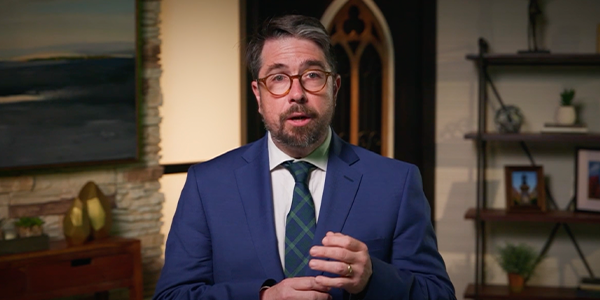
Dr. Timothy O'Malley, Ph.D., Associate Director for Research at the McGrath Institute for Church Life, opens the series with a timely reflection on the Eucharist as a source of unity. In this video, Dr. O’Malley offers three concrete ways Catholics can move beyond the divisions of our moment and become agents of unity in public life.
This article is transcribed from Timothy O’Malley’s Lecture The Eucharist as a Source of Unity, available for viewing on Manna.


