


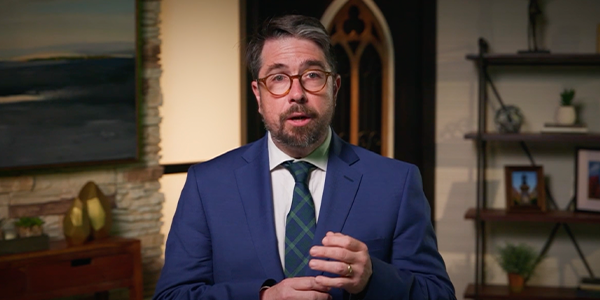
In Part One, Dr. Timothy O’Malley discussed how the Eucharist is the sacrament of unity in which the Church remembers who she is, born from the side of Christ upon the cross, a communion made possible through God's love, and how as a Eucharistic people we are called to be a people of unity. He offered three ways that we could become agents of unity in our nation. First, we are a communion of sinners and not the righteous. Second, our unity is not self-created but the result of Christ’s self-giving love. Third, as recipients of this love, we are called to offer that return gift of love wherever the Lord has called us. We continue here with the second invitation to become an agent of unity.
The Unity of the Church Is a Gift
Second, the unity of the Church is not the result of our own effort, but always comes as a gift from Christ. We don’t create unity. We receive it from the Lord.
In the United States, this is often hard to remember. We exist in a religious ecology that is voluntarist. I belong to the church where I want to belong. If I don't like the pastor, I go elsewhere. If I don't like the community, I'll find another. But Catholicism is different. The Church is called into existence through a gift she cannot create: the Eucharistic love of the Lord. On the night before he died—an atrocious death brought about by the very blame game described above—Jesus took bread and wine and gave them to us. The God-man facing death did not respond with hatred or violence, but a sacrificial gift of love. “This is my body. This is my blood for you. Do this in remembrance of me.”
And therefore, on every Eucharistic altar around the globe the faithful are called to be present to that reality. The Church comes into existence not through the creation of a Constitution. But through the blood and water that poured forth from Christ’s side upon the cross. Baptized into Christ, confirmed through the gift of the Spirit, I am called to belong to the Church.
Now I have to admit, if this unity was up to me, it wouldn't be very successful. As a sinner, I’d want to recreate the church in my own image and likeness. Everyone who doesn't agree with me is out. It would be a precarious unity. A unity based more on power and prestige than the Eucharistic love of Christ. When we forget this, factions develop in the Church. Factions that are competing with one another for money, fame and, ultimately, power.
Of course, the United States isn’t a Catholic country, but maybe the way that we Catholics think about unity, made possible through divine love, is important to the nation right now. Our politics in the present moment are certainly defined by almost rigorous factionalism. This or that political party is often treated as the advent of a purely temporal salvation. America will be made great again.
For nearly my entire political life, I’ve been told that every election is a matter of salvation. If the right candidate isn't elected, then our way of life is over. Our national unity is dependent on no other source than the political schemes of this or that candidate.
As Catholics, we can’t accept this story. There are values that unite us, that preexist the platform of any political party. Values that will continue even if an election doesn’t go our way. God loves us. All of us. God calls us into a unity where we are to love one another. This unity, and therefore the salvation of the world, is not dependent on political action, but on the self-giving love of God. Politics ain’t salvation.
As Catholics, we can participate in this 250th anniversary in a peculiar way. By examining who or what we worship. Do I worship power and prestige more than the Eucharistic love of Christ? Does our parish as a whole? Do we live more as Democrats or Republicans and less as disciples of Jesus Christ convoked to the Supper of the Lamb? Am I subject to the kind of factionalism that rips apart the body of Christ? A politics of disunity that rips apart the nation? Or am I committed to being a transformative agent of Christ’s Eucharistic love in the world. This leads me to my final point.
We Are to Become Protagonists of Love
As recipients of Christ’s self-giving love in the Eucharist, we are to become protagonists of love where we call home.
Some years ago, I heard the late and great Catholic journalist John Allen answer a question about renewal in the Church. Someone at a conference was asking when the Vatican was going to do something about this thing or that pastoral problem. He answered, “They're not, but you could.”
It's easy for Catholics, especially those of us committed to church life, to think about the institution of the Church. When is my parish going to start this program? When is my priest going to teach me more about the Eucharist? When will our diocese do something about building a new school in my neighborhood? Such institutional thinking is lovely. But it forgets the power of our Eucharistic agency.
As priests, prophets, and royal persons, as those consumed by Christ's love, we are to become agents of that Eucharistic love wherever we go. I want you to think for a moment about the great American Servant of God, Dorothy Day. Her conversion story, her role in founding the Catholic Worker movement, and her love of the Eucharist is well documented, in fact even in Day’s own writings. But it should be remembered that Day didn't wait to find out if her local parish was going to open a House of Hospitality. She certainly didn't wait for the city of New York to act. She did it. Infused with Christ's love, she took up an apostolate that was a prophetic response to the suffering and poverty of so many of her fellow New Yorkers. She is a Eucharistic missionary and her commitment to making the least of these her friends has changed our nation.
We should remember, dear friends, that we can be like Dorothy Day. In fact, the United States needs lots of Dorothy Days. It's easy to forget that the United States—in fact, really any nation—is a people committed to a form of life. Before the nation is a Congress, a Constitution, or an economy, the renewal of the United States isn't just a matter of elections or the work of governmental officials. It is the commitment of every man or woman in every neighborhood to the common good. The flourishing of my neighbor is my flourishing. And the suffering of my neighbor is my suffering. As Catholics, we call this solidarity, and it's the most Eucharistic of virtues.
So you want to renew the nation as a Catholic? Don't wait for your invitation from a political party or even your parish to do so. Act as one who is called to consecrate every crack and crevice of the world through your Eucharistic vocation. Be an agent of unity, dare I say Eucharistic unity, at the most local of levels. Open houses of hospitality where the hungry and thirsty can get a meal and experience friendship. You're worried about affordable housing in your neighborhood? Work often against the odds to create this housing so that your neighbor can have a roof over his or her head. You want to create a culture of life? Open up care centers in which pregnant women can receive any and all support that they need. Are you concerned about the way that workers are treated by a major industry in your town? Develop a business where employees are treated with dignity. Be there for one another, love one another.
This Eucharistic agency creates a culture of love, friendship, and support in local communities. It is the gift of American life that we as religious persons have the freedom to do this. Yes, we need to at times fight to maintain this freedom. But we don't need to wait for the passage of a law or the election of a candidate to build such bridges of unity. We are free to do so, in fact obligated to do so because of our Baptism.
In conclusion, dear friends, Pope Benedict XVI in his Apostolic Exhortation on Charity, once wrote “A Eucharist which does not pass over into the concrete practice of love is intrinsically fragmented” (Deus Caritas Est, no. 14). Those of us who regularly receive our Lord at Mass, who let our voices be united to one another in hymns of praise, must remember that we are called to love one another. Not just the faithful gathered in our little parish church, but every man or woman.
In this highly contentious time in the United States, where politics is too often controlling how we interpret the gospel, we can be agents of change. It is my hope that everyone who is on pilgrimage this summer, men and women of every race, gender and tongue, are witnesses to a different way of being human. We don't have to prefer division over unity. Hatred over communion. Violence before love. We can love one another. In fact, it's the Eucharistic Lord who brings this about. As we celebrate the 250th anniversary of the United States, as we prepare for the 2029 Eucharistic Congress, let us be agents of Eucharistic unity in a fractured world. I can think of no better way to renew the promise of this nation and the role of our one, holy, catholic, and apostolic Church in this national project.
Dr. Timothy O'Malley, Ph.D., Associate Director for Research at the McGrath Institute for Church Life, offers a timely reflection on the Eucharist as a source of unity. In this video, Dr. O’Malley offers three concrete ways Catholics can move beyond the divisions of our moment and become agents of unity in public life.
This article was transcribed from Timothy O’Malley’s Lecture The Eucharist as a Source of Unity, available for viewing on Manna.


