


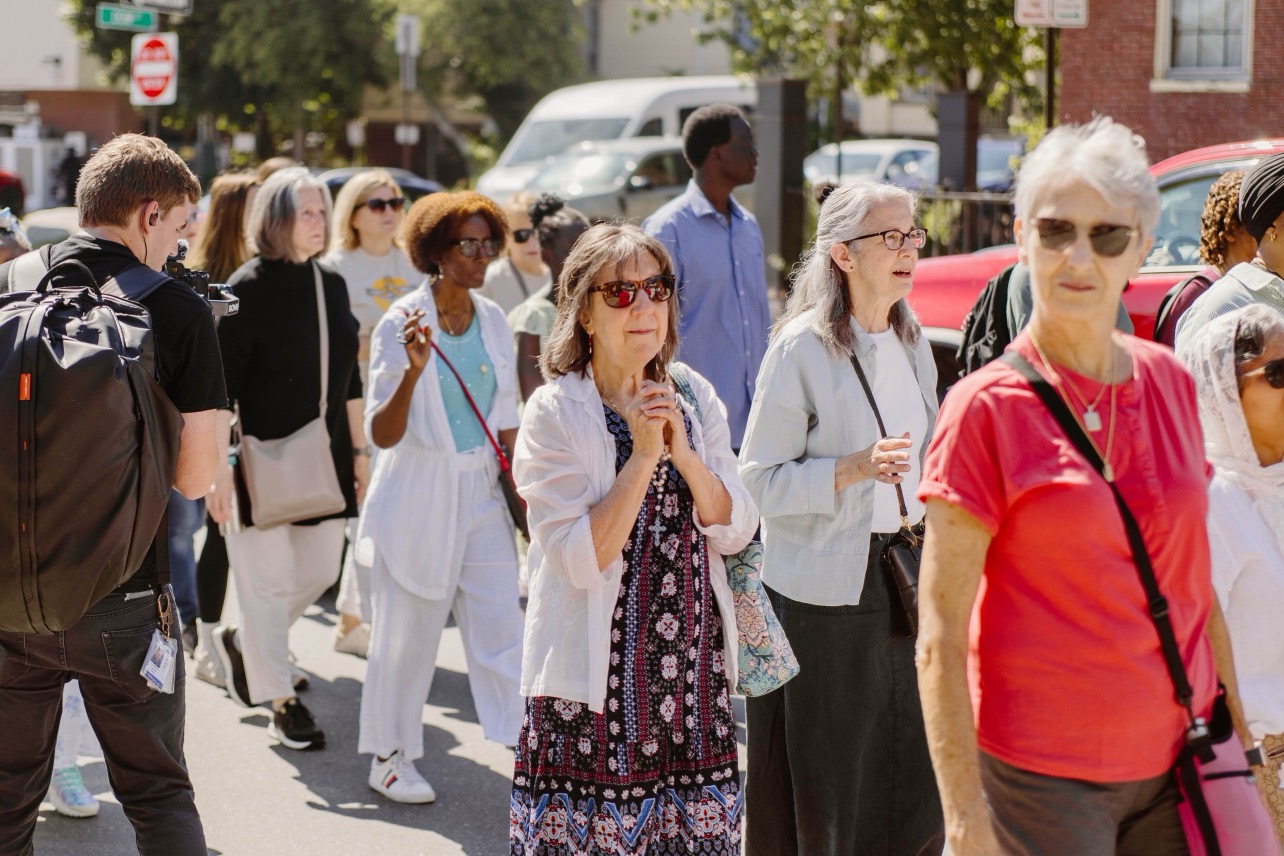
In just a matter of days, the Mother Cabrini pilgrimage route will culminate on June 5 in Philadelphia with a final Mass and then Eucharistic Procession. The blisters will start healing. The vans will start packing up. The perpetual pilgrims will return home to pick up their everyday, ordinary lives...
But will they be able to do that…?
Will any of us, after having witnessed from afar or walked this pilgrimage, ever be able to return to everyday, ordinary life?
That’s the point, isn’t it?
That life isn’t everyday. It isn’t ordinary. If we enter into what Christ in the Eucharist is pouring into the world and into our hearts, it is impossible that we could return to the way it was....to the way we were.
Let’s be honest: we don’t need another article summarizing what happened along the way of the pilgrimage, the miles covered, and the size of the crowds who gathered to pray and praise along the way. What the world needs—what your heart needs as the 2026 pilgrimage culminates in Philadelphia—is to understand the massive disruption that has occurred.
For weeks, the pilgrim route has brought Jesus into busy highways, quiet towns, and chaotic city centers. He has become palpably present in nursing homes, prisons, and pregnancy centers. Jesus came to halt us in our tracks. He came to pierce through the noise of our daily grind and whisper the definitive truth of human existence: We come from the very heart of the Father, and we are being drawn back into it.
All of us.
Every single person Jesus passed on those streets.
Everyone in all of history.
We have all emerged from the loving and creative hands of our Father, and all of us are called to union with Jesus that we might abide forever in the communion of life and love in the Trinity. As perpetual pilgrim Raymond Martinez realized in a deep way as he walked with Jesus, “Christ’s love endures, and his desire for every person to encounter him never wanes.” Jesus invites everyone to the banquet of eternal life.
So where do we go from here?
As the physical journey ends, here are three ways that your spiritual journey can be re-launched with greater intensity.
Keep refocusing the gaze of your heart
“Amazing grace. I once was blind and now I see.” Bishop Stephen Parkes lifted up this first transforming reality as the pilgrimage arrived in Savannah, defining it as “the ability to see, the ability to see the Lord, not just in a monstrance, but also in our hearts, being able to see the Lord in one another.”
To be on pilgrimage with Jesus in the Eucharist across thousands of miles is to undergo something radical: slowing down, allowing the dust to settle, purifying the eyes of the heart, and discovering that what we once “saw,” what may have once been “the most important things,” now have found their proper place within the context of the Kingdom of God that Jesus won for us. And all this might look very different than it did before. It might even look more beautiful.
This is what happened to the Samaritan woman. To the prodigal son. To Zacchaeus. To Saint Peter. To Saint Paul. And now it happens to us. Now we see!
It means experiencing the first tastes of the eternal wedding feast (see CCC 1405), and discovering this is what I wanted all along. The truly free human being is the one who finally desires what they were actually made for: the ecstasy and bliss of the Father's embrace. We are no longer living just to reach a far-off goal; we are living in communion right now, walking toward the eternal wedding feast with every breath.
As Angelina Marconi, one of the perpetual pilgrims, said: “The Lord captivates every heart who encounters his presence.”
Let the Eucharistic Heart of Christ captivate you
When we meet Jesus in the Eucharist, we come face-to-face with the Sacred Heart. And as Bishop William Koenig, Diocese of Wilmington, noted: “The Heart of Jesus is large enough to embrace every person, every sinner, every nation, every wound, every hope. It is a Heart that never grows tired of forgiving, never ceases seeking the lost, never stops loving.”
This boundless love is meant to capture us completely. Mary Carmen Zakrajsek, a perpetual pilgrim, recalled a powerful moment of this captivation during a mini-retreat at St. John the Evangelist Church in Severna Park, Maryland. Moved by a homily on Jesus' burning love, she went to confession, where the priest encouraged her to boldly repeat the phrase "Jesus, I trust in you" and to stop living in the past.
"When I emerged from confession," Mary Carmen shared, "I was very moved by the painting of Jesus crucified above the tabernacle and the words of the song being sung touched me: ‘You’re beautiful / Come and behold him / Isn’t he fascinating?’ At that moment, I was captivated by the Heart of Christ who loved me so strongly. I was able to trust God’s love anew and experience it with joy and gratitude."
This is the divine exchange of the pilgrimage. Bishop Joseph Williams, Diocese of Camden, explained it this way: “Jesus is taking our heart, sometimes cold, sometimes tired, sometimes confused, and he's putting it into his heart so that when he pulls it out, it's back on fire."
That fire immediately spills onto the sidewalks. Along the route, pilgrims recounted how they met two young men who asked for prayer on the spot—one for freedom from alcoholism, the other for the courage to live for God rather than human respect. Right there, they formed a prayer circle on the pavement. "People are so hungry for prayer," one of them reflected, "and it becomes an opportunity to introduce them to the One they are truly seeking."
Bring Jesus into someone else’s pilgrimage through life
In a pilgrimage we encounter our human fragility held by the merciful kindness of God who makes himself vulnerable in the Eucharist. We unite ourselves to Jesus who stays with us, wherever we are, however we are on any given day.
Admittedly, there can be a bit of a letdown at the end of a 60-day pilgrimage, as ordinary life with its messiness begins to settle back in. But the Eucharistic Pilgrimage doesn’t really end on July 5. It just turns the corner. It shifts its route into the city streets of our everyday lives. In our own quiet way, each of us carries Christ in procession wherever we go.
The world is starving for what you have witnessed. It wants the same experience of Jesus you have had. On Trinity Sunday, reflecting on the reading from Exodus where Moses was invited into the cloud to meet the Lord, Bishop Michael Martin, OFM Conv., delivered a piercing challenge to the crowds:
“The world wants the same experience Moses had. What do they get? You. You. You may be the only touchpoint of the Almighty. You have been invited into that cloud. Are you open to deepening that relationship? Are you willing to cultivate a deeper life of prayer, adoration, devotion... such that when you go out into the world, people notice something different about you?”
Mary Carmen shared a striking moment from her time on the road: “There were many moments in the street today when I just smiled and thought, ‘Wow. This is real. Jesus is right in front of me. At this intersection, crosswalk, and on the sidewalk.’”
Wow. This is real.
It is real that Jesus intends to use your ordinary life to show forth his blinding beauty and his mercy to a broken world. It is real that at every crosswalk, office space, and kitchen table, Christ is alive in you.
The end of the pilgrimage is not the time to fold things up and stow them away until next year’s Eucharistic pilgrimage. Now is your pilgrimage route. It begins today. Now is the time for you to live with the continuous awareness that Christ is alive in you at every crosswalk, office space, and kitchen table.
We leave the Mother Cabrini pilgrimage route not to return to the "same old" routine, but to live as a sent people–allowing the hidden, humble God within us to break through the spiritual famine of our age and guide a fractured humanity back to its eternal origin in the heart of the Father.


