


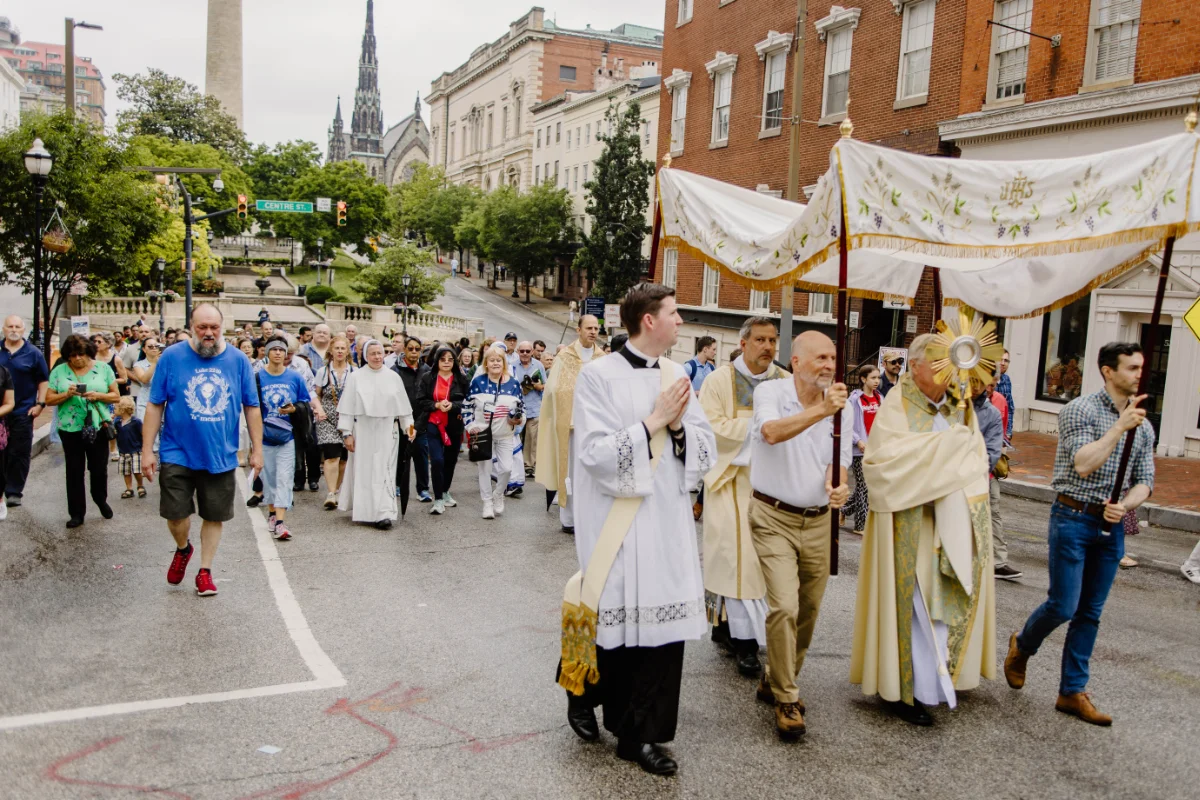
A procession.
Not a parade with its balloons, spectacle, and entertainment.
But the slow, measured, sure steps by which the Church goes out to meet the world, bearing the only thing she has to offer it: Jesus Christ.
“Today we walk with Jesus Christ, our redeemer, our Savior,” said Father Charles Trullois during the Eucharistic Procession through the streets of our nation’s capital on June 6. “We walk with him through the streets of our nation’s capital. We pray for our country. We intercede for our leaders. We ask forgiveness for our sins. We thank God for his blessings. We praise him publicly and without shame. And perhaps someone today watching from a distance, someone wounded, someone searching, someone who has drifted from God, may encounter Christ again.”
The Eucharistic Pilgrimage, this public procession of Christ through our streets, has become a school of life. It is teaching us something surprising about the way God acts in the world. We expect great signs when we encounter God. Instead, again and again, he comes quietly, humbly, almost unnoticed, asking only that we make room for him.
Jesus arrives quietly
This was the first year I had the opportunity to meet up with the Eucharistic pilgrimage in person, so I wasn’t sure what to expect. At first, I was excited to see some of the “visuals” of the pilgrimage. I was excited to see the perpetual pilgrims in person, maybe meet one, see the van that Jesus rides in during the pilgrimage. We were early for the Holy Hour for Vocations on June 5, so we waited in the quiet Basilica of St. Mary, as the pews gradually filled with others who had come to take part in the pilgrimage, many of whom we knew from daily Mass and others who had come from across the Arlington Diocese. The sense of recollection was deepening.
And then nothing dramatic or exciting. Father Hathaway, the Rector, entered with the Eucharist through a side door and exposed Jesus on the altar and our hour-and-a-half of Adoration began. Pilgrims scattered here and there among the parishioners. Later, I realized that this is perhaps the deepest lesson of the pilgrimage. We come looking for the event, the pilgrims, the stories, the movement across the country. Jesus simply comes through the side door, so to speak, and takes his place at the center.
We were awakened from the business of the day to the one thing we were made for: worship—and the one thing we will be doing for all eternity: giving glory to the Father, to the Son, and to the Holy Spirit.
Beatrice was moved by this time spent with Jesus in the Eucharist and shared: “The only thing that ‘happened’ is that Jesus came to be with me and with everyone in that church. He touched tender and quiet places in me, places that opened precisely because he came in such a quiet and tender way. And it's not over, because Jesus is still quietly arriving through the side door in my heart, and he wants to stay.”
“In those quiet moments when I empty my heart while gazing at the Lord,” May told me, “he gently enters my heart and fills it with steadfast love and divine mercy—reminders that I am seen and precious in his eyes.”
Jesus goes out to seek people
The God who comes through the side door is also the God who goes out into the streets. The One who waits for us in silent adoration is the same One who refuses to remain enclosed within church walls. The pilgrimage reveals both movements of divine love: Christ comes to us and then Christ goes in search of others. He seeks out where people live and work and entertain themselves. He wants to be wherever they struggle and suffer.
Marcel Ferrer, one of the perpetual pilgrims, shared with me an encounter that deeply touched him. “I met a woman the other day who told me her husband had recently been deported. She was really busy trying to sort that out, but she decided to come to one of our Eucharistic events because she wanted to see us pilgrims as a source of hope. I think this really proves why we all have to be Eucharistic missionaries. When we receive Jesus in the Eucharist, his presence should change the way we live. We can't keep the light of the Eucharist to ourselves we have to share it. The presence of Jesus is powerful, and when we receive Jesus in the Eucharist, we become ‘mini-Christs,’ and we offer the hope that life's struggles and difficulties can be overcome by Jesus' love for us.”
I met Ashley and Duke over the weekend. They are from Ft. Lauderdale, Florida, and after having been at the launch of the pilgrimage at the National Shrine of Our Lady of Le Leche in St. Augustine, they flew to Virginia to join the pilgrimage for a week. “Doing this pilgrimage,” Ashley said, “has opened my eyes to bringing the Eucharist and Christ to others. Usually we go to church. That’s our norm. But bringing Jesus outside of the church and seeing people get excited about it, observing the questions that get evoked in them.... I have this new, deeper appreciation of what it is to follow Christ, which has been so powerful for us.”
Jesus forms a eucharistic people
While keeping up with the events of the Eucharistic Pilgrimage—taking full advantage of the photos posted on Instagram!—I’m realizing anew that worship is not some add-on to life that interests religiously-inclined people. Worship and adoration are the only proper responses to our Creator. It’s a fully human response to the one who fills all that exists with his love and goodness. It is, indeed, “our duty and our salvation—always and everywhere—to give God thanks.”
Perhaps that transformation happens in the same way Jesus entered the Basilica that evening—not through the front door with fanfare, but through a side door. God often forms us quietly, through daily Mass, hidden acts of service, ordinary fidelity, and moments of prayer that seem small at the time. The Eucharist teaches us that the deepest changes in a human life often happen in hidden ways.
Bishop-Elect Gary Studniewski, in his homily for Corpus Christ on June 6, explained how the Eucharist forms us. “In the Eucharist, we not only remember what Jesus did to rescue us from sin and death. The scripture readings help us to remember, but we participate in the saving events which are represented here at the altar.... He offers himself to the Father as a living sacrifice for our salvation. We get to participate in that offering.... Well, then we partake of the body and blood of Christ to participate in the very life of Jesus, to have a share in the life of God himself. It is to participate in eternal life.”
Jesus teaches us how to build a new world
The Eucharist forms us to bless, to give thanks, and to build a new world. Angelina Marconi, one of the perpetual pilgrims, reflected on her time at Greensboro Urban Ministries serving those experiencing homelessness: “I met, there, a beautiful woman, and was moved by how she shared with us her faith in God. We sang together, worshiping him, and prayed with her. I received such a gift, witnessing her faith in God and the strength she had through him.”
In the words of Leo XVI in his homily on Corpus Christi in “Plaza de Cibeles” (Madrid), the Eucharist is: “A school that teaches us to kneel before God and before our neighbor, because no one can kneel before the Lord and despise their brother; A school that teaches us of the gratitude of love that becomes a gift, so that it may flow among us and break the chains of all selfishness; A school from which we learn that God is a real presence and that we too are called to be present in the realities and challenges of society, not shying away, but personally committing ourselves to the building of the common good.”
Perhaps that is the lesson I personally am taking from this year's pilgrimage. Christ is still coming through side doors. He enters quietly into churches, hearts, cities, and communities. We are more attentive to this during the 60 days of the Eucharistic pilgrimage, but it happens every day. Christ comes not to draw attention to himself but to draw us into the life of God. And if we allow him to remain, he slowly teaches us to become what we receive: a Eucharistic people who give thanks, bless others, and help build a world renewed by his presence.
What lesson are you taking away from the 2026 National Eucharistic Pilgrimage?


